Finding Customer Churn Indicators in Your Support Data

Alex Barnett
CEO
Insight
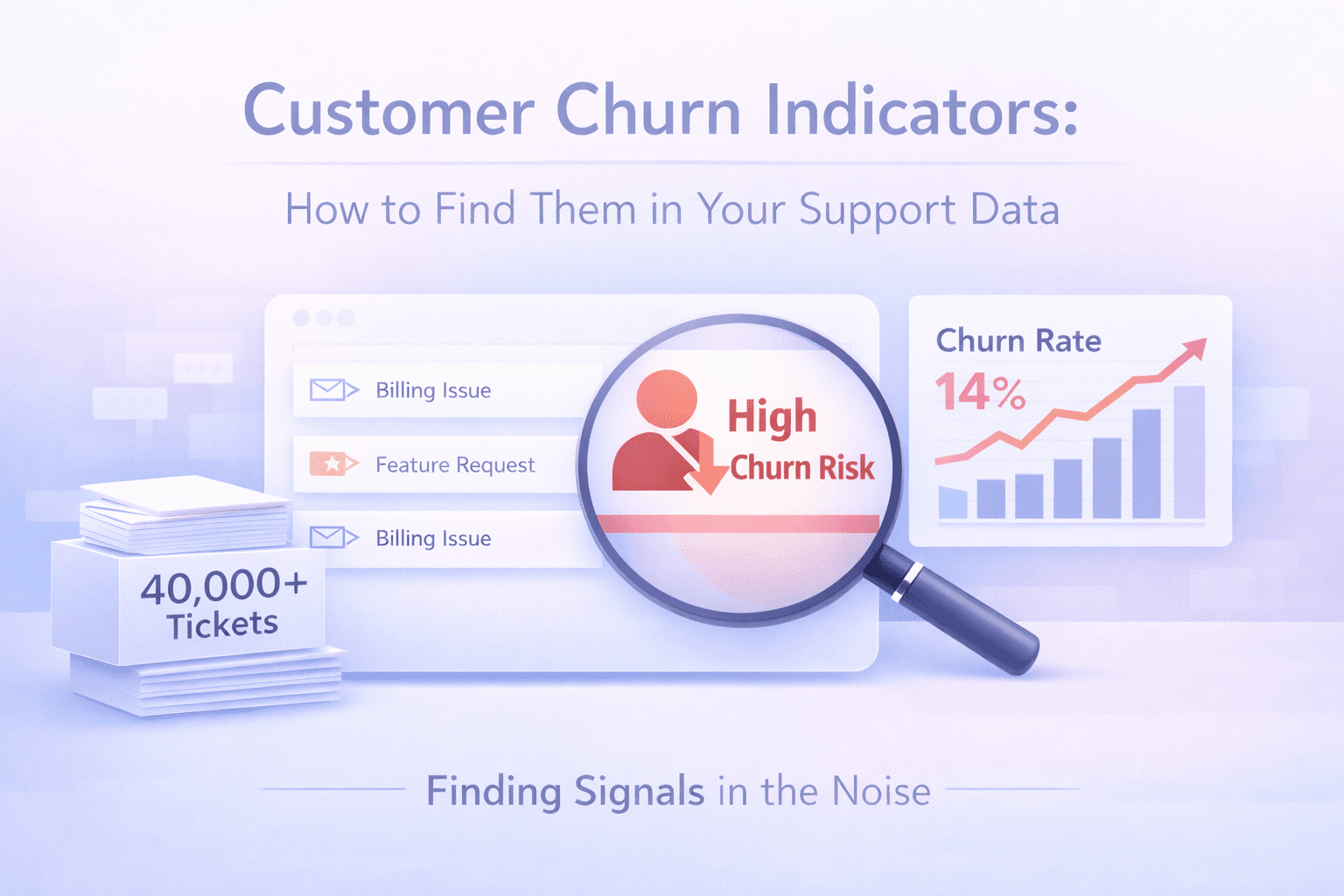
Your team already knows what's driving churn, but the data to prove it is buried in 40,000 tickets from last quarter.
That's not a data problem. It's a signal problem.
The Challenge Isn't Insight. It's Proof
Support leaders have strong gut instincts. We've all seen the patterns:
The integration that breaks on upgrade.
The billing flow nobody can navigate without calling in.
The feature customers keep asking about.. that the product team keeps deprioritizing.
You know. But knowing isn't the same as proving.
When you walk into an executive review or a product planning meeting, instincts don't move roadmaps or justify headcount. The needle moves when a number is tied to a business outcome: "This issue is linked to +14% churn in accounts <12 months old."
Getting that number without a data analyst, without weeks of manual review, without building a tagging taxonomy from scratch… that's the hard part.
Why Manual Support Ticket Tagging Fails
The standard approach goes like this: you decide what the problems probably are, create tags for them, and train your agents to apply them consistently.
It sounds reasonable, but has two fatal flaws.
You only find what you're already looking for.
If you don't have a tag for the specific edge case that's actually driving churn, it never shows up in your data. Your blind spots become invisible.
No two agents tag the same ticket the same way.
One agent's "Feature Request" is another's "Bug." One team's "Billing Issue" is another's "Pricing Concern." By the time you aggregate it, you're not looking at data… you're looking at noise.
Present that to a VP of Product and they'll find the holes in seconds. You'll be back at square one with less credibility than when you started. Traditional support ticket tagging simply can't scale to meet this challenge.
A Better Method: Quantified Customer Feedback at Scale
At Make Data Speak Human, we've learned from how enterprise companies run large-scale user research.
Instead of asking agents to categorize tickets in the moment, build a structured rubric for categorization. A set of precise questions applied uniformly across thousands of conversations, scored consistently, then aggregated to find patterns.
Think of it like a survey, except instead of asking customers to rate their experience, you're systematically reviewing what they already told you.
The Signal Engine applies this method to quantify customer feedback systematically. Here's how it works in practice:
Build the Rubric Around What Actually Matters
Rather than generic sentiment, the rubric asks specific questions:
Is the customer expressing frustration with a core product workflow or something else?
Have they referenced alternatives or competitors?
Are they escalating or de-escalating over time?
Did this conversation end with the customer more or less confident than it started?
These are qualitative judgments, but our rubrics make them consistent and repeatable across every ticket, not just the ones a human happened to review.
Apply Statistical Significance to Filter Signals from Noise
This is where churn prediction from support data gets important. If 12 customers mention a specific integration failure and three of them churn the next month, that might be a coincidence. If 340 customers mention it and the churn correlation holds, that's a signal.
The goal isn't to surface every complaint. It's to surface the ones where the data is strong enough to act on.
Aggregate Scores into Trends, Not Individual Flags
A single ticket won't tell you much beyond how one person feels. In operations, we care about the trends affecting thousands.
The interesting findings are rarely the ones you expected. Customers who contact support and get a clean resolution early often retain better than customers who never reach out at all. Engagement with support, when it goes well, builds trust. That pattern exists in most support datasets but nobody sees it, because most teams don't build tags for "interactions that went well."
What Customer Churn Indicators Actually Look Like
At the ticket level, churn risk signals tend to cluster around a few patterns in high-volume support environments:
Going quiet on solutions. Early on, customers try your fixes. They respond, they test, they follow up. When that stops (when they read your response and don't reply) they've often already made a mental decision. The ticket stays open, but the customer has already moved on.
Misaligned expectations. The customer thought the product did X; it does Y. Support explains the workaround and the customer says thanks. Then they contact support again next month about the same gap.
The indirect comparison. Nobody emails support to say they're evaluating competitors. They say "our last tool handled this automatically" or "we're rethinking our stack." At scale, those phrases are measurable customer churn indicators.
Customer Retention Signals Look Different
While churn indicators warn you of risk, customer retention signals show you where trust is building:
Expansion questions. "Can we add seats for another team?" or "Does this integrate with X we're rolling out?" These aren't support requests. They're a customer building the product further into their org.
Detailed configuration questions. Not "this is broken" but "can I set it up this way for this specific use case?" That's someone investing time in understanding the edges of a product, not someone looking for the exit.
Grace under friction. "I know you'll sort this out" isn't just politeness. It's a customer who has decided to trust you despite the problem. That goodwill is measurable, and it predicts retention as reliably as frustration predicts churn.
From Insight to Operations
When you can quantify customer churn indicators and retention signals at the support level, the conversation with leadership changes. You're no longer reporting ticket volume or average handle time. You're reporting revenue risk.
For product teams: Instead of "support says this is broken," you walk in with a ranked list of friction points sorted by their impact on churn backed with confidence intervals. That's a defensible roadmap input.
For customer success: Instead of working down a renewal list by date, your team works a risk-ranked list based on actual signals. The accounts that need a call before they decide to leave get the call.
For support leadership: You can show which resolution types actually affect retention and build the case for investment in training, tooling, or specialized tiers based on evidence.
The goal isn't a new dashboard. It's the ability to walk into any room and show exactly how your team's work connects to the business staying healthy.
Turn Your Support Data into Revenue Intelligence
Every customer who left this quarter told you it was coming. The signal was there—it just never made it out of the queue.
Make Data Speak Human’s Signal Engine transforms your support conversations into quantified churn prediction you can act on.
Schedule a demo to see how our signal engine surfaces the customer churn indicators already hiding in your tickets.



