Silent Churn

Alex Barnett
CEO
Insight
The intuitive theory
Most retention playbooks lean on the same idea. When a customer is about to leave, they get loud. They open an angrier ticket. They complain. They show you, in your support data, that they're on the way out. Catch the signal, intervene, save the customer.
Whole teams get organized around this idea. Dashboards get built for it. Quarterly goals get written against it.
We tested it. The data didn't agree.
What we ran
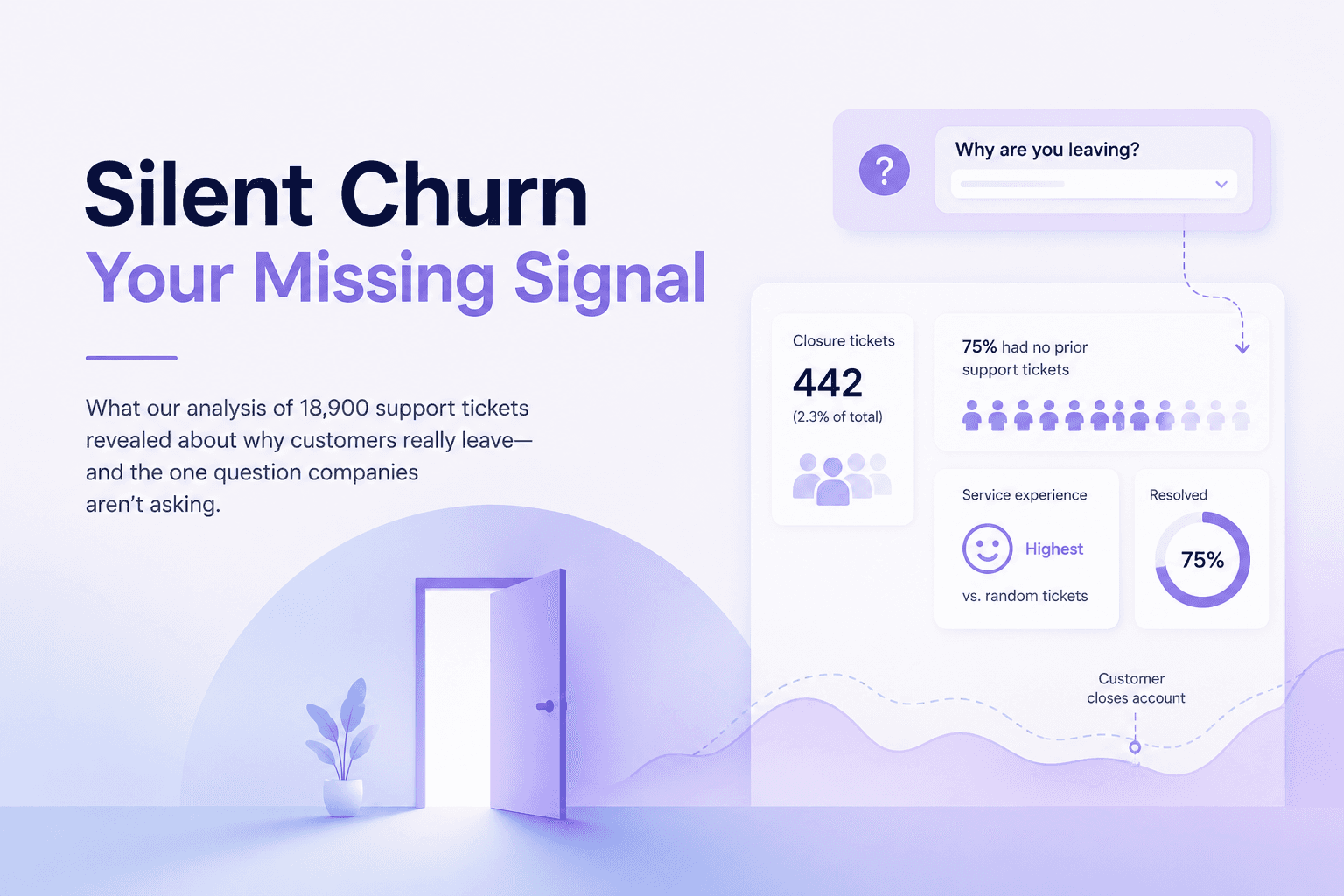
Real online marketplace, 14 weeks of customer support data, 18,900 tickets in the window. In that window, 442 customers filed a ticket asking to close their account.
For each of those 442 customers, we pulled every other support ticket they had filed in the 180 days BEFORE they finally closed. Then we asked the Signal Engine to read all of it and tell us what the lead-up actually looked like. We compared the lead-up tickets to a random sample of 200 customers who weren't closing, so we could see what was actually different.
Surprise 1: most people who closed didn't complain first
Of the 442 customers who filed a closure ticket, only 95 had filed any other support ticket in the 180 days before they closed. About 1 in 4.
The other three quarters didn't show up in support at all in the lookback window. There was nothing to catch. You can't be early to a signal that doesn't exist.
Surprise 2: the ones who DID complain didn't complain about anything you could've fixed
The 1 in 4 who filed lead-up tickets, what were they about? We coded each one against 14 churn-driver categories (technical issues, agent behavior, refund disputes, pricing complaints, and so on) and compared the distribution to the random control sample.
It was almost the same. Reading-quality complaints, technical issues, refund disputes, all of those showed up at roughly the same rate in lead-up tickets as in tickets from customers who weren't about to close. There was no distinctive "angry pre-churn" pattern. The lead-up cohort looked like everyone else.
Surprise 3: support handled the lead-up tickets BETTER than average
This is the one that took a beat.
We looked at how well support handled tickets in each group. The lead-up tickets came out HIGHEST on service experience score. Highest on "did the customer walk away satisfied." 45% of those tickets ended on improving or stable-positive sentiment, against 30% for a random ticket. 75% of the issues got resolved.
The customer wrote in. Support fixed it. The customer left the conversation happy.
Then, weeks or months later, the customer closed.
Those tickets weren't a warning shot. They were a normal support interaction that ended well. Whatever drove the decision to close was happening somewhere outside the support channel.
So what IS the lever?
We ran two completely independent analyses on the same data, without letting either know what the other was doing.
The first counted up which CAUSE customers cited when they filed their closure ticket. The biggest stated cause, by far, was that the deletion flow itself was broken. "I want to delete but only see deactivate." The submit button freezes. It's unclear what data actually gets erased. Customers were closing because closing didn't work, and they were saying so in the ticket they filed to close.
The second analysis took the Signal Engine's per-ticket recommendation ("what should this company have done to save this customer") and clustered them by meaning. The largest actionable cluster: ask the customer WHY in the in-app form, before processing the closure.
Two methods, same answer. The highest-leverage retention move on this data wasn't a support workflow and it wasn't a CSM outreach play. It was a one-line change to the closure form. Add a "why are you leaving?" step. A dropdown is enough.
3 in 4 closure tickets today read "Please delete my account" and nothing else. If the form asked, 3 in 4 closures would carry an actual reason. That is a different conversation, and a different product roadmap.
The bigger lesson: be suspicious of any AI that never tells you the data won't help
The honest output of this investigation was partly "here's what's going on" and partly "here's what this data CAN'T tell you, and here's the data source that would."
The cohort we analyzed is customers who came to support to close. If most of a company's customers close through in-app self-service and never reach support at all, the lead-up findings will be biased toward people for whom the self-service flow failed. So one of our explicit recommendations was: pull the list of every customer who actually closed in the window, not just the ones who touched support, and rerun the analysis on the full denominator.
When you're using an AI tool to make a real business decision, that's the move you want it to make. The opposite is a tool that confidently produces an answer to any question, including the ones it can't actually answer. If your AI never tells you "this dataset won't support this conclusion," you don't have a measurement instrument. You have something that talks like one.
What to do with this if you run support
Don't build your retention strategy around "find the angry pre-closure ticket." For most of your closers, those tickets don't exist. For the rest, they look like every other ticket and they get resolved.
Put the question to the customer in the product, at the moment they are trying to leave. A required field, even a small one, gets you more useful churn intelligence than any dashboard.
When you ask an AI tool a question about your support data, watch for whether it tells you what it CAN'T answer. That is the harder thing to build, and it is the difference between a demo and a tool you'd trust with a quarter's plan.



