AI Documentation Management: What Ancient Scribes Knew About Curation

Rachel Harrison
CSM
Insight
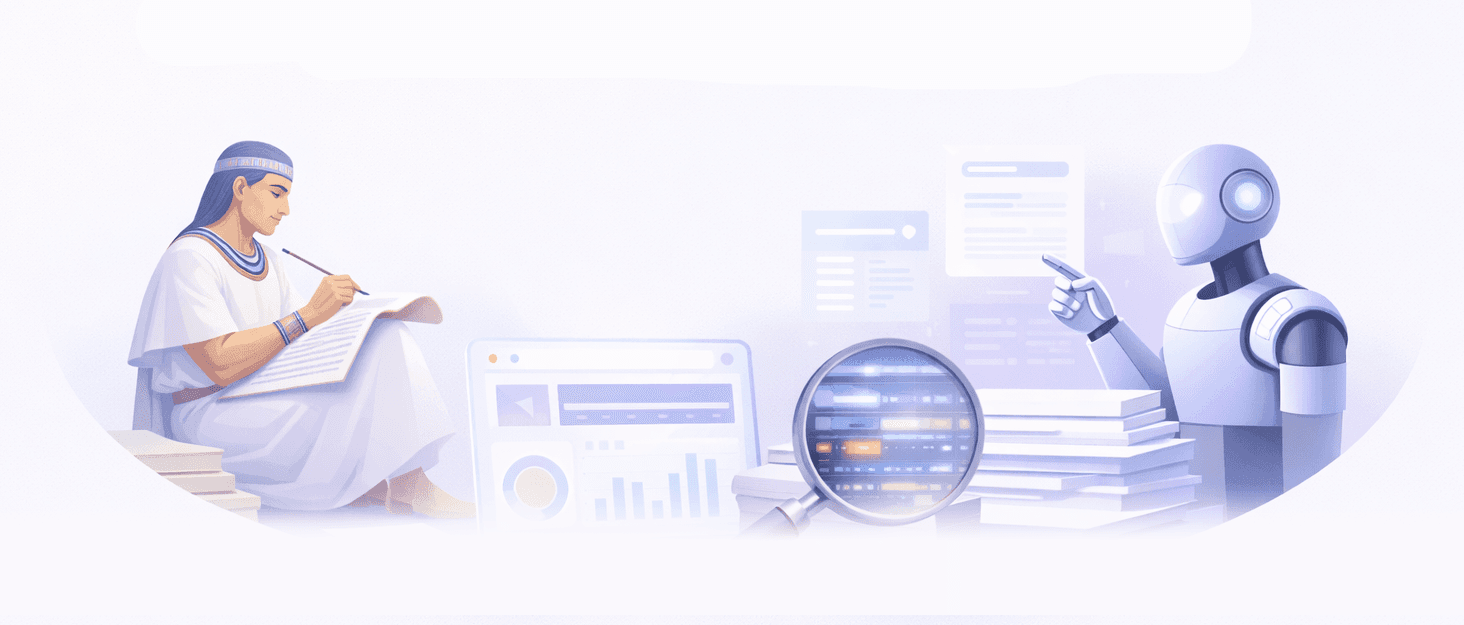
When consumers first got printers - everyone printed everything. Memos nobody read. Reports destined for filing cabinets. Draft after draft after draft. The technology made production effortless, so production exploded, but most of it was noise.
This same pattern is playing out with AI documentation management today. We've solved the "hard to create documentation" problem, only to replace it with a new one: being buried under an avalanche of related-but-not-relevant content. The ability to generate AI content at scale has flipped the old challenge on its head. Instead of not having enough documentation, teams are now drowning in it.
What Egyptian Scribes Understood About Information Curation
Recently I watched a video by Tom FitzGerald proposing that one reason Egyptian civilization lasted for millennia was the importance they placed on documentation. Ancient Egyptian scribes treated the accuracy and restoration of records as a sacred duty, training for years to copy and transcribe text without error. For scribes, recording something incorrectly wasn't just a mistake, it was considered dangerous, a violation of Ma'at.
To the Egyptians, Ma'at was more than a goddess. She represented truth, balance, and cosmic order standing against chaos. In the context of record-keeping, this made a scribe's work existential. They understood two things we've forgotten: information is fragile without active maintenance, and writing essentially defines reality for future generations.
If a scribe recorded information incorrectly, it wasn’t a typo, it was chaos entering the system. They feared that failing to curate and verify records would blur the line between fact and fiction, leading to societal decay.
Today, accuracy is treated as an afterthought.
A Lesson from Wikipedia
The fear of unverified information should feel familiar. Remember when Wikipedia was the thing teachers warned you about? "Anyone can edit it. You can't trust it." In the early days, they were right, Wikipedia was chaotic, inconsistent, and sometimes wildly wrong.
But Wikipedia eventually developed rigorous curation processes. Citations became mandatory. Editors who cared deeply about accuracy emerged. The community built systems to surface and correct errors. Now Wikipedia is considered a legitimate starting point for research precisely because it solved the information curation problem.
Finding Signal in Noise
The revolution Wikipedia underwent has yet to reach the wider internet. Anyone can publish anything, and AI can generate infinite content on any topic. The result is a greater burden on readers to determine what's accurate. The scribes would be horrified.
This need for curation exists almost everywhere information accumulates, especially in customer support environments. Every day, support teams collect massive amounts of qualitative data: complaints, suggestions, frustrations. It's valuable information that becomes buried in thousands of tickets, chats, and emails. Effective qualitative data analysis requires surfacing patterns from this chaos, but finding the signal in all that noise can feel nearly impossible.
The Philosophy That Drives Everything We Do at Make Data Speak Human
Whether you're navigating the vast internet or a company's support ticket history, the solution isn't less information, it's better curation. Simply reducing the number of support tickets or limiting available sources doesn't help people understand things better; it just narrows their view.
What teams actually need is support ticket analysis that surfaces patterns, quantifies feedback, and reveals the insights already hiding in their data. The same AI creating the abundance problem can solve it. By using knowledge management AI for curation( not just creation) we can transform information overload into deeper understanding.
This philosophy drives everything we do at Make Data Speak Human. We use AI to index and surface insights from customer support conversations, finding the signal buried in the noise. Instead of feedback dying in the ticket queue, it becomes quantifiable, searchable, and actionable.
The Egyptian scribes understood that information without curation invites chaos. We're bringing a little Ma'at back to customer support.
Ready to turn your support data into actionable insights? Schedule a demo to see how Make Data Speak Human can help.



