User Feedback Loop for Engineering Teams: A CTO's Guide

Jacob Fry
Co-Founder
Featured
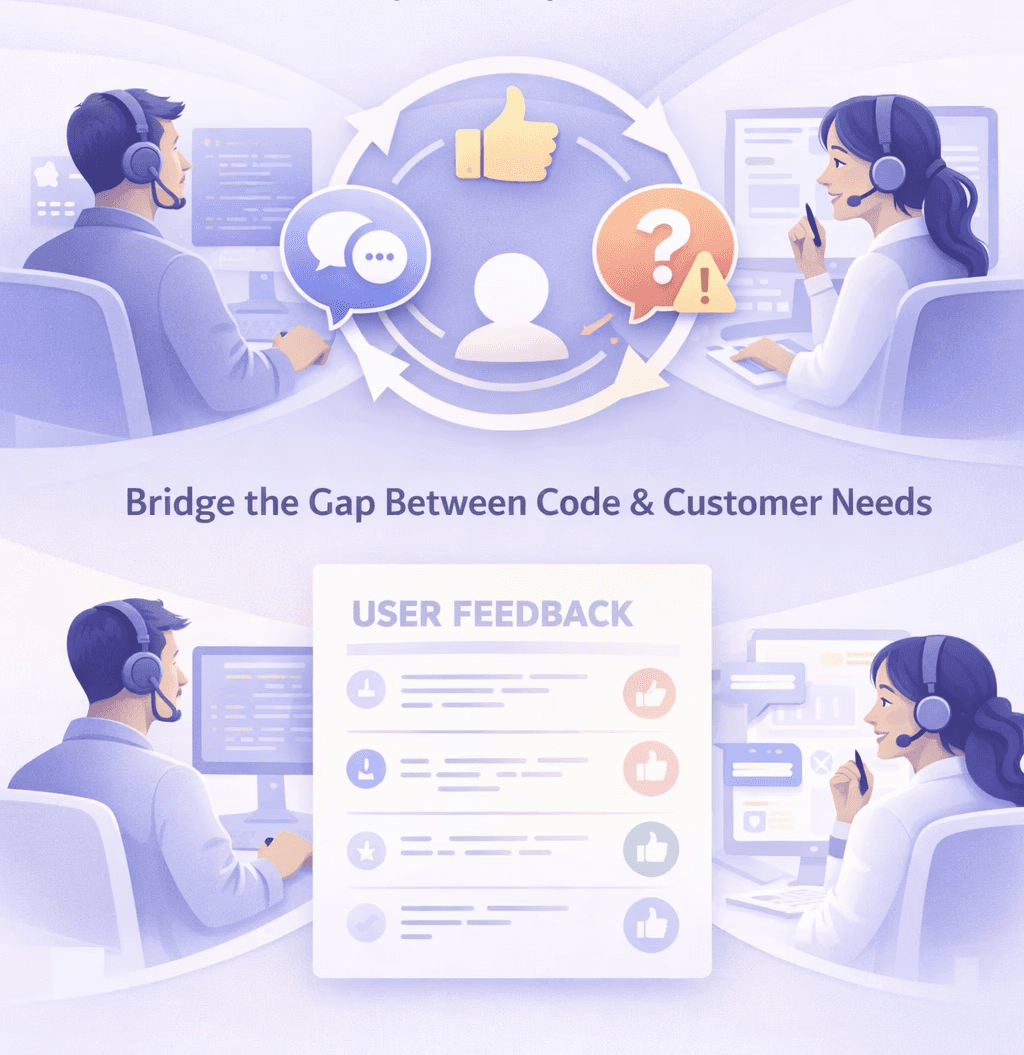
As engineers, we love technical challenges, clean code, and systems that scale. But there's a trap many of us fall into, especially when transitioning from client-based consulting to building scalable products: we start working in a vacuum. Without a user feedback loop for engineering teams, we're left guessing at what customers actually need.
Early in my career, I worked in custom development. It was fast-paced and reactive. Whatever the client needed, we built it often on the spot. But later, when I transitioned into the prop-tech space to build a scalable real estate platform, things changed. We were physically and operationally far removed from the end users.
I found myself in what I call the "engineering echo chamber." We were bouncing ideas off other engineers, not real estate agents. We were building things that were technically impressive, but we were just guessing at what the user actually needed.
Here's what I've learned about breaking out of that silo and why the relationship between Support and Engineering is the most undervalued asset in a tech company.
The "Technically Correct" Trap
There's a distinct difference between a product that "works" and a product that works for the user. When you're siloed, you tend to measure success by uptime, latency, and code quality. But your users measure success by whether they can actually solve their problem without a headache.
I remember building out the admin dashboard for our real estate platform, where agents could see information about the ads they ran and the leads coming in. We built it to display all the data they might need: ad performance, lead sources, conversion metrics, everything. Technically, it worked perfectly. The data was there, the queries were fast, everything rendered correctly.
But we threw a lot of information at users all at once with limited explanation of what any of it meant. The user experience took a backseat because we were prioritizing getting features out the door. Without direct feedback from agents actually using it day-to-day, we'd build something, see that it technically worked, and move on to the next ticket before really polishing it or making it intuitive.
When Gamification Backfires Without Real-Time User Feedback
A perfect example of this disconnect was when we tried to fix that engagement gap by "gamifying" the platform.
We had this idea to increase interaction on that dashboard. We wanted agents to run more ads and understand the backend tools better. So we built a system with a cute little character, pop-ups, and tutorial-style overlays. Inside our office, we thought it was great. We thought, "This is interactive! This will get people clicking!"
In reality, it just added noise.
The users didn't want a "fun" character popping up while they were trying to decipher complex metrics. They just wanted to understand the data. It didn't pan out because we were solving a problem we thought existed, using a solution that engineers found cool, rather than addressing the friction users actually felt.
We built a feature that technically worked but failed the user because we lacked that immediate feedback loop. If we'd had access to real-time user feedback from support conversations, we would have known that clarity (not gamification) was the real need.
Support Is the Missing Bridge to Customer-Driven Product Development
This is where the relationship between Engineering and Support becomes critical.
Usually, engineers are shielded from support tickets. We treat them as distractions or "escalations" that get in the way of our sprint. But that separation is exactly what creates the engineering echo chamber. Because I wasn't handling support requests, I missed out on the friction points. I also missed out on the "woohoo" moments and the satisfaction of seeing a user genuinely get value from what we built.
Support teams possess the data that engineers are guessing at. They know exactly why that admin dashboard is overwhelming. They know that the "cute" gamification character is actually annoying. Tapping into this knowledge is the foundation of customer-driven product development by building based on what users actually say, not what we assume.
How to Build a User Feedback Loop That Actually Works
To break the engineering echo chamber, you need a bridge tool. Something that translates the chaos of thousands of support tickets into aggregate, actionable feedback for developers.
That's what excites me about what we're building at Make Data Speak Human. We aren't just building another AI wrapper; we're building a system that acts as that missing bridge. For an engineer, having immediate, aggregate feedback on a deployment is a game changer. Instead of waiting for a quarterly review or a churn report to find out a feature missed the mark, you can see the friction in real time.
It shifts the engineering mindset from "Does it compile?" to "Does it solve the problem?"
Stop Guessing. Start Building What Users Need.
If you're an engineering leader, take a hard look at your support team. If you view them as a separate silo, you're building in the dark. But if you treat them as your primary source of product truth, you can finally stop guessing and start building what your users actually need.
Ready to close the gap between support insights and engineering priorities? Schedule a demo to see how Make Data Speak Human turns support conversations into a real-time user feedback loop for engineering teams. You can also explore our pricing to find the right fit for your team.



